
Wednesday, 24 October 2012
Mark Scheme Targets
As a group we set ourselves a target of getting a level 4's throughout our work. By looking at the below mark scheme lots of work will have to be completed to a level of "excellent". We believe though that if we apply ourselves it is possible to do.


Tuesday, 23 October 2012
Camera
Brief summary on camera techniques - distance

In the image above (http://www.aber.ac.uk/media/Documents/short/gramtv.html) it demonstrates many of the shots used within film.
XLS - Extreme Long Shot
LS - Long Shot
MLS - Medium Long Shot
MS - Medium Shot
MCU - Medium Close Up
CU - Close Up
BCU - Big Close Up
XCU - Extreme Cole Up
All these shots give different aspects to film and are essential in helping the film makers deliver their message.
Long shots, which show all or the majority of the subject are used to often to create establishing shot's. These are where the backgrounds are often shown and sets the location for the rest of the section. Long shots can also be used to to draw attention away from certain characters because they can often fit many into that scene.
One way that medium shots can be used is to display emotion, unlike in a long shot where facial expression isn't really picked up upon you can now see it and the effect it cause, body language might also be something that would be picked up upon.
Close ups show the greatest amount of detail and are used for that purpose. An example of a close up could be shooting someones forehead and showing a bead of sweat dropping down in a tense scene. As this is all that the audience would see, it gives it importance due to it being unmissable.
In conclusion the correct distance of shot is important as it impacts the viewer in different ways. If I look to how it is used in Thriller and in particular se7en (see lower in down the page) they use large amount of close ups. As raised in the analysis it not only gives a sense of ambiguity but it also makes sure that the audience has an understanding of what is happening.
Camera technique - Angle

Like
distance, the angle is an important factor to take into consideration
when creating films and are used to affect the way the audience thinks
when seeing something.
Low Angle - This is where the camera is below the subject resulting in them appearing bigger. This can then help show the subject to have power or dominance.
High Angle - This is where the subject is shot from above and has the opposite effect of a low angle shot. When looking down upon the subject it often makes them appear small and weak.
A mix of both these shots in thrillers would be good as it helps show balance between two people which is something that features quite highly in thrillers.
Eye-level - An eye level shot is quite neutral in terms of giving the subject a sense of power, however it shows the audience what it would be like talking to the subject.
Bird's Eye - Birds eye shots are where the camera is at an angle so high it is looking down on the action. These can give the viewer an alternate view on what is happening on screen
Worm's Eye - In this shot the camera is now almost on the floor looking upwards. Shots like this are good to show people walking or like a low angle shot make the subject look more powerful.
Canted - When a shot is taken at an different angle to normal everything appears different and therefore create a sense of unease.
Point-of-view (POV) - This is where a shot is made is displayed as it would be from the subjects view. This is good as it gives a good sense of what the situation would be like to the audience.
How it's applied in thrillers
Although almost all of the above techniques are used in thriller films some of them are used more than others. One of them that appears frequently throughout are close ups. The best example of this is the opening of Se7en (as seen previously in the blog) This uses only close ups and focuses on small details of objects. Doing this creates an ambiguous tone and the fast paced editing combined with the non diegetic sound creates a tense and scary mood.
High and low angled shots are something which also appear to a lot. These help portray things as either bigger or smaller then they would be seen as a eye level shot. By shooting something from above it's going to make the subject look smaller and less threatening whereas something from a low angle will have the reverse affect.
Camera technique - Angle
Low Angle - This is where the camera is below the subject resulting in them appearing bigger. This can then help show the subject to have power or dominance.
High Angle - This is where the subject is shot from above and has the opposite effect of a low angle shot. When looking down upon the subject it often makes them appear small and weak.
A mix of both these shots in thrillers would be good as it helps show balance between two people which is something that features quite highly in thrillers.
Eye-level - An eye level shot is quite neutral in terms of giving the subject a sense of power, however it shows the audience what it would be like talking to the subject.
Bird's Eye - Birds eye shots are where the camera is at an angle so high it is looking down on the action. These can give the viewer an alternate view on what is happening on screen
Worm's Eye - In this shot the camera is now almost on the floor looking upwards. Shots like this are good to show people walking or like a low angle shot make the subject look more powerful.
Canted - When a shot is taken at an different angle to normal everything appears different and therefore create a sense of unease.
Point-of-view (POV) - This is where a shot is made is displayed as it would be from the subjects view. This is good as it gives a good sense of what the situation would be like to the audience.
How it's applied in thrillers
Although almost all of the above techniques are used in thriller films some of them are used more than others. One of them that appears frequently throughout are close ups. The best example of this is the opening of Se7en (as seen previously in the blog) This uses only close ups and focuses on small details of objects. Doing this creates an ambiguous tone and the fast paced editing combined with the non diegetic sound creates a tense and scary mood.
High and low angled shots are something which also appear to a lot. These help portray things as either bigger or smaller then they would be seen as a eye level shot. By shooting something from above it's going to make the subject look smaller and less threatening whereas something from a low angle will have the reverse affect.
Monday, 22 October 2012
Sound
In todays lesson we revised and learnt some new things on "sound". The first feature we revisited was to combination of diegetic and non-diegetic. We need to now this as almost all media texts contain a combination of the two and is essential when producing our films.
We then looked at something new to us; ambient sound or background noise. Ambient noise comes in two ways either foley or natural. Foley is something which is artificially put in and isn't picked up on screen. The opposite is natural which is where the sound heard is all from the on screen action. The use of both are important with foley sounds being able to enforce something whereas natural shows whats happening.
Other aspects we saw come from voice, the first being dialogue. Dialogue is people talking and helps give a basic narrative to a story. The next type is voice over this is where you can't tell where a voice is coming from but you can hear one over the top of what is on screen.
The final two types of sound we looked at where parallel and contrapuntal. Parallel sound is where the sound fits the action or mood on screen i.e in a horror if there was a killer in a house the music could be tense and and shrill. The opposite of this is contrapuntal where the music does not an example of this could be if in the same situation of a killer in a house some upbeat dance music was playing it wouldn't fit the action and would display a different tone.
Overall what I've learnt is that sound overall does a great deal in order to reflect the moods of film and how its use can change the effect a lot
We then looked at something new to us; ambient sound or background noise. Ambient noise comes in two ways either foley or natural. Foley is something which is artificially put in and isn't picked up on screen. The opposite is natural which is where the sound heard is all from the on screen action. The use of both are important with foley sounds being able to enforce something whereas natural shows whats happening.
Other aspects we saw come from voice, the first being dialogue. Dialogue is people talking and helps give a basic narrative to a story. The next type is voice over this is where you can't tell where a voice is coming from but you can hear one over the top of what is on screen.
The final two types of sound we looked at where parallel and contrapuntal. Parallel sound is where the sound fits the action or mood on screen i.e in a horror if there was a killer in a house the music could be tense and and shrill. The opposite of this is contrapuntal where the music does not an example of this could be if in the same situation of a killer in a house some upbeat dance music was playing it wouldn't fit the action and would display a different tone.
Overall what I've learnt is that sound overall does a great deal in order to reflect the moods of film and how its use can change the effect a lot
Thursday, 18 October 2012
Final Survey Evaluation
In total we received over 100 responses on or survey, we were pleased with this as it gave us a much larger audience than our initial pilot surveys. This meant we were given a more accurate picture on the general opinions of the public.

In this question we asked for the age of the participant; either 15-17 or 18+ we received the following results 70% to 30% respectively. This shows that most of the people currently viewing are work at the age of 15-17. This would suggest that making a film with a age certificate of 15 may be more appropriate to the people who had contributed to our survey.
The second question we asked was "Do you prefer films with a 15 or 18 age certificate and why?". Although we had lots of responses the majority verdict did go towards 15's. This ties into the idea of making a film that are already viewing and contributing towards our work.

The nest question we asked was "Do you pay attention to title sequences?". We found this to be important to us to decide wether it should be something that we spend a lot of time on or simply just exert our efforts elsewhere within the project. We scored a 62% rating on people paying attention on the title sequences. This has showed us that it is something that we will have to closely consider as people will be noticing it.


The next question we asked was "What is your favourite sub-genre?". This may come in useful to us when deciding ours to see what is popular, however one thing that may be a concern could be that the most popular genres are heavily saturated and there wouldn't be room for us to put a similar film without copying aspects of other similar. The flip side of this is that we could go into a very open style of sub genre however it may not be as successful or well perceived.
On this question we received the most popular to be "supernatural" with 22% and the lowest being "political" only receiving 5%

The sixth question we asked was "What do you expect to see in an opening of a thriller film?". Some of the responses can be seen in the image above, the results we mainly saw were the stereotypical things you'd expect to see in a thriller. We could use these and stick to some of the conventions of thriller however we wouldn't want to over do it and make it cheesy and cliched.

The next question we asked was "What do you think ruins a thriller film?". Knowing this will help us make sure not too over-do any aspects that would potentially put off viewers. Scoring the highest was "gory scenes" with 26% however this was closely followed by "Homophobic/Racial discrimination" with 25%. By seeing that these two can put people off quite a lot we should remember that when making the film.

Our eighth question was "Out of all these popular films, which one do you think has a successful title sequence?". By finding this out we can then go on to look at why it worked so well and then influenced by it's success try to make our own that will have a similar effect. Toping the list was James Bond. We didn't find this surprising when we saw our results as we knew how iconic and loved the opening sequences of James Bond films are. Although we do appreciate it James Bond is so iconic and famous anything similar to it would be instantly though of as something from the James Bind series, for this reason it would be unpractical to use it in our title sequence.

To follow on from question eight we asked "Why do you think it is successful?". With the highest score of 47% was music, however as raised in the previous question if people were referring to James Bond it could be because it is iconic and not because it actually had the best effect. However we still understand that music and the other options are all important and not something we should under estimate
In Conclusion I believer my group and I have learnt from this questionnaire and will be a valuable tool to look back upon once we start planning and developing our film.
In this question we asked for the age of the participant; either 15-17 or 18+ we received the following results 70% to 30% respectively. This shows that most of the people currently viewing are work at the age of 15-17. This would suggest that making a film with a age certificate of 15 may be more appropriate to the people who had contributed to our survey.
The second question we asked was "Do you prefer films with a 15 or 18 age certificate and why?". Although we had lots of responses the majority verdict did go towards 15's. This ties into the idea of making a film that are already viewing and contributing towards our work.
The nest question we asked was "Do you pay attention to title sequences?". We found this to be important to us to decide wether it should be something that we spend a lot of time on or simply just exert our efforts elsewhere within the project. We scored a 62% rating on people paying attention on the title sequences. This has showed us that it is something that we will have to closely consider as people will be noticing it.
Following that we asked "Do you prefer title sequences to be fast or slow?". We received a 57% response saying fast, this would imply that making a fast sequence would be more popular however a possible alternative would be to try and work out why slower title sequences aren't so successful and try to amend this.
The next question we asked was "What is your favourite sub-genre?". This may come in useful to us when deciding ours to see what is popular, however one thing that may be a concern could be that the most popular genres are heavily saturated and there wouldn't be room for us to put a similar film without copying aspects of other similar. The flip side of this is that we could go into a very open style of sub genre however it may not be as successful or well perceived.
On this question we received the most popular to be "supernatural" with 22% and the lowest being "political" only receiving 5%
The sixth question we asked was "What do you expect to see in an opening of a thriller film?". Some of the responses can be seen in the image above, the results we mainly saw were the stereotypical things you'd expect to see in a thriller. We could use these and stick to some of the conventions of thriller however we wouldn't want to over do it and make it cheesy and cliched.
The next question we asked was "What do you think ruins a thriller film?". Knowing this will help us make sure not too over-do any aspects that would potentially put off viewers. Scoring the highest was "gory scenes" with 26% however this was closely followed by "Homophobic/Racial discrimination" with 25%. By seeing that these two can put people off quite a lot we should remember that when making the film.
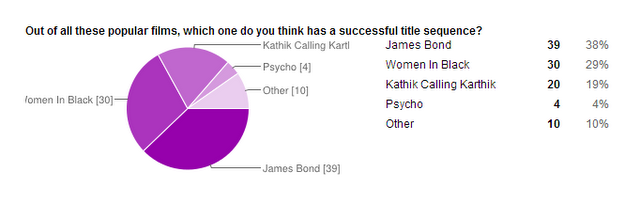
Our eighth question was "Out of all these popular films, which one do you think has a successful title sequence?". By finding this out we can then go on to look at why it worked so well and then influenced by it's success try to make our own that will have a similar effect. Toping the list was James Bond. We didn't find this surprising when we saw our results as we knew how iconic and loved the opening sequences of James Bond films are. Although we do appreciate it James Bond is so iconic and famous anything similar to it would be instantly though of as something from the James Bind series, for this reason it would be unpractical to use it in our title sequence.
To follow on from question eight we asked "Why do you think it is successful?". With the highest score of 47% was music, however as raised in the previous question if people were referring to James Bond it could be because it is iconic and not because it actually had the best effect. However we still understand that music and the other options are all important and not something we should under estimate
In Conclusion I believer my group and I have learnt from this questionnaire and will be a valuable tool to look back upon once we start planning and developing our film.
Wednesday, 17 October 2012
Se7en Opening Analysis
|
Film Title: Se7en
Director: Kyle
Cooper
|
||
|
|
Technique
|
Effect
(Analysis)
|
|
Camera – distance, angle,
movement…
|
|
|
|
Editing – speed, style…
|
|
|
|
Sound – effects, musical
score…
|
|
|
|
Mise-en-scene – props,
costume, setting, lighting, colour…
|
|
|
|
Titles – font, colour,
placement, over black / over clip…
|
|
|
Pilot Survey
Before Producing our final survey (see further down the page) we deicded to create a pilot survey to assess the best way on sending the questions out and also what we wanted to find out.

By asking how old poeple are we can see what the most common age is of people viewing our work, this can come in handy when it comes to producing our work and what ge certificate we select.
Asking what certificate people prefer is also important to give us a general opinion for when we decide on what are can be, however the previous question does have to be taken into consideration as if everyone was under 18 but they prefered 18 films it wouldn't be appropriate.
As we will be making an opening sequence it is quite important we understand what people enjoy. For this reason we ask do they like fast or slow openings. Although this is a start we could develop it in are final one by asking why they like it.
 The final question, we asked what people generally expected to see in a thriller film.
Most of the answers varied which did not help us as each of the audience liked different things. On our next survey, we should keep the answer limited so that they have a choice of what they expect to see to make it less varied, helping us get the best results.
In conclusion this pilot has helped show us how we can develop are questions in order to find out the information we want.

By asking how old poeple are we can see what the most common age is of people viewing our work, this can come in handy when it comes to producing our work and what ge certificate we select.
Asking what certificate people prefer is also important to give us a general opinion for when we decide on what are can be, however the previous question does have to be taken into consideration as if everyone was under 18 but they prefered 18 films it wouldn't be appropriate.
As we will be making an opening sequence it is quite important we understand what people enjoy. For this reason we ask do they like fast or slow openings. Although this is a start we could develop it in are final one by asking why they like it.
 The final question, we asked what people generally expected to see in a thriller film.
 Most of the answers varied which did not help us as each of the audience liked different things. On our next survey, we should keep the answer limited so that they have a choice of what they expect to see to make it less varied, helping us get the best results.
In conclusion this pilot has helped show us how we can develop are questions in order to find out the information we want.
Jess' Analysis of "Frozen"
I have decided to analyse a completely different type of thriller. I am going to analyse a film called frozen which is an American film. The film is about three skiers stranded on a chairlift and forced to make life-or-death choices that prove more perilous than staying put and freezing to death. I am hoping to find out if the opening of Frozen is anything like the Bollywood thriller I analysed. I will have to look out for the same things such as: how the music and sound sets a tone in the opening, how the camera and editing present characters and how the camera uses shots to establish the location and characters body language, how the mise-en-scene creates a type of atmosphere within the opening and if the title sequence has any relevance or creates suspense.
Frozen is a 2010 American thriller and horror film written and directed by Adam Green and starring Kevin Zegers, Shawn Ashmore, and introducing Emma Bell.
Music/soundFirstly, the sound in the title sequence sets a very sinister tone in the movie as you hear a large sound of lighting and thunder which is scary for the audience. The scene opens up with only diagetic sound. The diagetic sound is of the equipment rustling and creaking. This creates a very ominous tone as it sounds scary and mysterious as the audience does not know what is going to happen. After this, the non diagetic sound comes in, the sound is very upbeat and fast which create a very positive tone in this scene which is very different to the diagetic sound which was heard before. All of this happens very fast (in the first minute) - This is significant because it is exciting for the audience as the scene and tone has changed numerous times which is very thrilling. The diagetic sound in the background helps make the scene look and feel more realistic as you can hear people talking and people skiing. This helps make the location and story line more believable for the audience.
Camera/editing
The film opens up with various close ups of the electronic ski equipment being moved. This reinforces the ominous tone as the close ups of the metal rustling make it look like something will break or something bad will happen. The camera then switches to a long shot of the mountains to establish the location they are in. This helps the audience see and view where they are and what the atmosphere is like.The director did this because the audience could get a more advanced insight of the scenery. The camera then focuses on people on the ski lifts. This already tells the audience that the ski lift in the movie plays a big part because of the amount of shots the director has used of it. The camera then switches to a mid shot of the three protagonists. The director cleverly uses close ups of them all, one by one to show their importance in the film. The camera shoots each character at eye level and over the shoulder to show the audience that they are all equal and as important as each other.
Mise-en-scene
The lighting is very dark when the film opens up. This is because the director wants to achieve a sinister tone and atmosphere in the start of the film. However, the next shot juxtaposes as he lighting is very natural, not too bright but not too dark as it is in the middle of the day. The lighting is also helping making the scenery look realistic because it is very natural. The clothing on the characters is mostly the same, large jackets, trousers and snow boots. This is what the audience would expect them to be wearing as the film is based on a ski resort. All the ski equipment such as the ski lift, cafes etc helped make the shots look authentic and realistic. It also gives the audience a more advanced insight on what it looks like when you go skiing.
Title sequence
The title sequence is very simple in Frozen. It has some interesting parts such as when it says which company made the film it has vibrant colors such as a bright blue. However, it then goes straight into telling us the main cast members. It has a black background with white writing. Even though these two colors contrast, neither of the colors are vibrant which kind of makes the movie come across depressing. The font is in serif which makes the title sequence look very elegant, sophisticated and professional.
What I've Learnt
Reading this analysis, one of the features that stands out to me is how the filmakers set pace. The name "Frozen" makes you think about having to escape the cold for your life in the context which is what the filmakers enforce by the use of non-diegetic sounds. By using a quick beat song it gives pace and helps set up the resulting story
Frozen is a 2010 American thriller and horror film written and directed by Adam Green and starring Kevin Zegers, Shawn Ashmore, and introducing Emma Bell.
Music/soundFirstly, the sound in the title sequence sets a very sinister tone in the movie as you hear a large sound of lighting and thunder which is scary for the audience. The scene opens up with only diagetic sound. The diagetic sound is of the equipment rustling and creaking. This creates a very ominous tone as it sounds scary and mysterious as the audience does not know what is going to happen. After this, the non diagetic sound comes in, the sound is very upbeat and fast which create a very positive tone in this scene which is very different to the diagetic sound which was heard before. All of this happens very fast (in the first minute) - This is significant because it is exciting for the audience as the scene and tone has changed numerous times which is very thrilling. The diagetic sound in the background helps make the scene look and feel more realistic as you can hear people talking and people skiing. This helps make the location and story line more believable for the audience.
Camera/editing
The film opens up with various close ups of the electronic ski equipment being moved. This reinforces the ominous tone as the close ups of the metal rustling make it look like something will break or something bad will happen. The camera then switches to a long shot of the mountains to establish the location they are in. This helps the audience see and view where they are and what the atmosphere is like.The director did this because the audience could get a more advanced insight of the scenery. The camera then focuses on people on the ski lifts. This already tells the audience that the ski lift in the movie plays a big part because of the amount of shots the director has used of it. The camera then switches to a mid shot of the three protagonists. The director cleverly uses close ups of them all, one by one to show their importance in the film. The camera shoots each character at eye level and over the shoulder to show the audience that they are all equal and as important as each other.
Mise-en-scene
The lighting is very dark when the film opens up. This is because the director wants to achieve a sinister tone and atmosphere in the start of the film. However, the next shot juxtaposes as he lighting is very natural, not too bright but not too dark as it is in the middle of the day. The lighting is also helping making the scenery look realistic because it is very natural. The clothing on the characters is mostly the same, large jackets, trousers and snow boots. This is what the audience would expect them to be wearing as the film is based on a ski resort. All the ski equipment such as the ski lift, cafes etc helped make the shots look authentic and realistic. It also gives the audience a more advanced insight on what it looks like when you go skiing.
Title sequence
The title sequence is very simple in Frozen. It has some interesting parts such as when it says which company made the film it has vibrant colors such as a bright blue. However, it then goes straight into telling us the main cast members. It has a black background with white writing. Even though these two colors contrast, neither of the colors are vibrant which kind of makes the movie come across depressing. The font is in serif which makes the title sequence look very elegant, sophisticated and professional.
What I've Learnt
Reading this analysis, one of the features that stands out to me is how the filmakers set pace. The name "Frozen" makes you think about having to escape the cold for your life in the context which is what the filmakers enforce by the use of non-diegetic sounds. By using a quick beat song it gives pace and helps set up the resulting story
Subscribe to:
Posts (Atom)